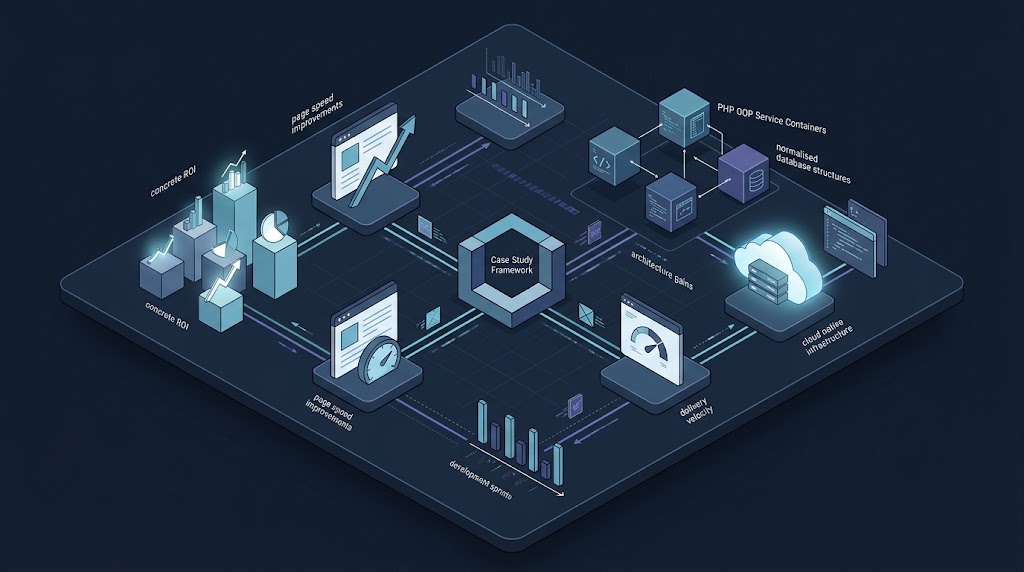
Custom PHP OOP Architecture vs. Heavy CMS: Building High-Concurrency Web Apps

BLUF Summary: Enterprise clients demanding high-concurrency web applications outgrow monolithic CMS platforms due to bloated database queries and middleware overhead. Transitioning to a decoupled, custom PHP OOP architecture—leveraging clean domain-driven design, optimized MySQL indexing, and automated CI/CD pipelines—reduces latency by up to 70% and eliminates platform licensing bottlenecks.
The Core Agency Bottleneck
Digital agencies scaling into enterprise contracts frequently hit a performance wall when relying on traditional Content Management Systems (CMS) for complex, high-concurrency applications. While out-of-the-box platforms accelerate initial prototyping, their generalized plugin ecosystems, dynamic table meta-abstractions, and unoptimized ORM layers introduce severe latency under load. CTOs and agency founders inherit fragile codebases that struggle to scale past a few thousand concurrent requests without expensive vertical scaling or convoluted caching layers.
Switching to custom PHP Object-Oriented Programming (OOP) architectures allows engineering teams to strip away unnecessary overhead and tailor every database call, routing mechanism, and service container to the application's exact domain logic.
| Metric / Dimension | Heavy CMS Platforms | Custom PHP OOP Architecture |
|
Database Overhead |
High (Excessive meta-tables & joins) |
Minimal (Normalized schemas, explicit indexes) |
|
Concurrency Ceiling |
Low-to-Moderate (Plugin blocking & hooks) |
High (Stateless services, horizontal scaling) |
|
Security Surface |
Large (Vulnerable third-party plugins/themes) |
Controlled (Audited proprietary codebase) |
|
CI/CD Integration |
Complex (Proprietary deployment states) |
Seamless (Containerized pipelines, automated testing) |
Technical & Operational Architecture
A high-performance custom PHP OOP backend requires a strict adherence to SOLID principles, dependency injection, and decoupled service layers. Rather than relying on monolithic execution paths, modern enterprise backends isolate concerns across dedicated modules.
-
Domain-Driven Design (DDD): Separate core business logic from infrastructure concerns (database drivers, HTTP wrappers) to ensure testability and code maintainability.
-
Database & Indexing Strategy: Utilize raw PDO or lightweight query builders with strict MySQL indexing ($B\text{-Tree}$ indexes on foreign keys, composite indexes for filtering). Avoid recursive entity metadata queries.
-
Caching & Session Management: Offload session states to Redis clusters and implement application-level caching for non-volatile reference data, keeping database connection pools lean.
-
Asynchronous Processing: Delegate heavy background jobs (e.g., webhook notifications, report generation, asset processing) to message queues like RabbitMQ or Redis Streams, preventing HTTP worker thread starvation.
Step-by-Step Execution Protocol
Transitioning your agency's delivery pipeline from monolithic CMS builds to high-performance custom PHP OOP architecture requires a rigorous, repeatable engineering protocol:
-
Architecture & Domain Modeling: Map out bounded contexts, define database schemas, and establish strict class hierarchies utilizing strict typing (
declare(strict_types=1);) in PHP 8.x. -
Environment Containerization: Dockerize the development and staging environments. Mirror production configurations using Nginx, PHP-FPM, and MySQL containers to eliminate environment drift.
-
Automated CI/CD Pipeline Setup: Configure GitHub Actions or GitLab CI to trigger automated test suites (PHPUnit for unit and integration testing, PHPStan for static analysis) on every pull request. Automate zero-downtime rolling deployments via SSH or Kubernetes clusters.
-
Load Testing & Profiling: Run automated load testing scripts (e.g., k6 or Apache Bench) against staging endpoints to identify memory leaks, bottleneck queries, and concurrency breaking points before client handoff.
Continue Reading
Preparing Your Agency's Tech Infrastructure for Q4 High-Volume Traffic

5 Signs Your Agency Is Losing Client Revenue to Technical Debt